
The December 2026 Rate-Hike Shock: How Sticky 3.7% CPI Reprices Corporate Borrowing & Floating Debt
Institutional analysis of the late-2026 Federal Reserve hawkish pivot (3.75%-4.00% base rate, 3.7% CPI) and how treasurers stress-test Interest Coverage Ratios on floating-rate debt.

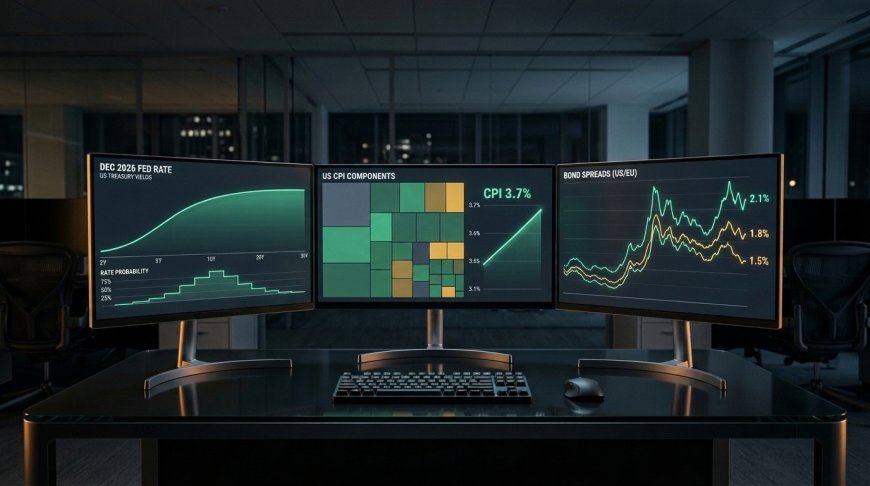
Why Sticky 3.7% CPI Forces a Hawkish Repricing in Late 2026
With headline CPI lingering near 3.7% and PCE at 3.6% against a 3.75%–4.00% federal funds target range, Federal Reserve policy has shifted from gradual easing back toward tightening risk. Each 25-basis-point hike directly lifts SOFR-linked corporate credit lines, compressing borrower Interest Coverage Ratios and free cash flow.
Markets entered autumn 2026 expecting benign disinflation, yet September's 25-basis-point increase and hawkish October FOMC minutes—released in November 2026—forced fixed-income desks to reprice the front end of the Treasury curve. When central banks prioritize anchoring inflation expectations at 2.0% over equity market support, variable-rate borrowers lose the refinancing tailwind they relied on during prior cycles.
Corporate treasurers and credit analysts quantify balance-sheet vulnerability to a December 2026 rate hike using the Interest Coverage Ratio (ICR) and the Debt Service Coverage Ratio (DSCR):
ICR = EBIT / (Debt_fixed * r_fixed + Debt_floating * (SOFR_new + Spread))
Where EBIT is trailing twelve-month Operating Income, SOFR_new reflects the post-hike Secured Overnight Financing Rate, and Spread is the borrower's credit margin (typically 225 to 450 basis points for mid-market leveraged loans). Once ICR falls below 2.0x, senior lenders frequently trigger technical covenant breaches, freezing revolving credit availability.
Sovereign Base Rate vs. Real CPI Spread Tracker
Adjust the interactive sliders and parameters below to calculate real-time figures for this scenario:
Floating-Rate Exposure: Stress-Testing Corporate Balance Sheets
Consider a mid-market industrial distributor generating $8.4 million in annual EBIT while carrying $45 million in total debt: $15 million in fixed-rate equipment notes at 5.25% and $30 million on a floating-rate term loan priced at SOFR + 325 bps. At a 3.85% SOFR benchmark (7.10% all-in floating cost), annual interest expense totals $2,917,500—yielding a comfortable 2.88x Interest Coverage Ratio.
Now model a hawkish 50-basis-point cumulative tightening across December 2026 and Q1 2027, pushing SOFR to 4.35% alongside a mild 8% cyclical revenue slowdown that trims EBIT to $7.5 million:
| Stress Scenario ($45M Debt Stack) | SOFR Benchmark | Floating Rate (SOFR+325) | Annual Total Interest | EBIT | Interest Coverage (ICR) |
|---|---|---|---|---|---|
| Baseline (Oct/Nov 2026 Pause) | 3.85% | 7.10% | $2,917,500 | $8,400,000 | 2.88x (Compliant) |
| Dec 2026 +25 bps Hike | 4.10% | 7.35% | $2,992,500 | $8,100,000 | 2.71x (Watchlist) |
| Hawkish +50 bps + Margin Compression | 4.35% | 7.60% | $3,067,500 | $7,500,000 | 2.44x (Tight Cushion) |
| Severe +100 bps + 15% EBIT Drop | 4.85% | 8.10% | $3,217,500 | $7,140,000 | 2.22x (Near Covenant) |
Notice the asymmetric sensitivity: even a modest 50-basis-point shift combined with slight top-line softening reduces pre-tax cash flow by $1,050,000 annually. For private-equity-backed firms operating at 5x–6x EBITDA leverage, a 100-basis-point upward shift in the policy corridor can consume 100% of discretionary capital expenditure budgets.
Real Yield Compression & Equity Valuation Multiples
Rising short-term policy rates also alter Discounted Cash Flow (DCF) valuations across high-multiple growth equities. Because the Risk-Free Rate (R_f) anchors the Weighted Average Cost of Capital (WACC), every 50-basis-point upward shift in 2-year and 10-year Treasury yields reduces the present value of long-duration cash flows maturing in years 6 through 10. Value-oriented enterprises with strong current free cash flow and low net leverage outperform capital-intensive unprofitable peers during hawkish central bank regimes.
"When headline CPI refuses to break below 3.5% in a full-employment economy, central banks cannot manufacture a soft landing through rate cuts. CFOs must treat 4%+ base rates as the structural operating floor rather than a temporary anomaly."
Four Treasury Hedging Tactics Before the December FOMC
Finance chiefs and commercial borrowers can insulate 2027 operating budgets using four concrete balance-sheet actions:
- Execute Interest Rate Caps or Pay-Fixed Swaps: Lock in SOFR ceilings on 50% to 75% of floating-rate principal via amortizing pay-fixed interest rate swaps or out-of-the-money SOFR caps before implied swaption volatility spikes further.
- Sweep Idle Operating Cash into T-Bills: Offset rising borrowing costs by sweeping non-interest-bearing checking balances into 4-week and 13-week Treasury Bills earning ~3.9%–4.5% state-tax-exempt yields.
- Accelerate Working Capital Release: Every $1,000,000 freed from slow-moving inventory or overdue Accounts Receivable and applied to a 7.35% revolver yields a risk-free, guaranteed 7.35% pre-tax return.
- Renegotiate Covenant Step-Downs Early: Proactive lender engagement prior to Q4 audited statements allows management to reset fixed-charge coverage cushions before technical defaults occur.




















Comments