
Manufacturing Cost of Goods Manufactured (COGM): Prime Costs, Conversion Economics, and Batch Sizing
A comprehensive operational accounting guide for manufacturing executives to calculate Cost of Goods Manufactured (COGM), balance prime costs against conversion costs, and optimize batch production sizing.

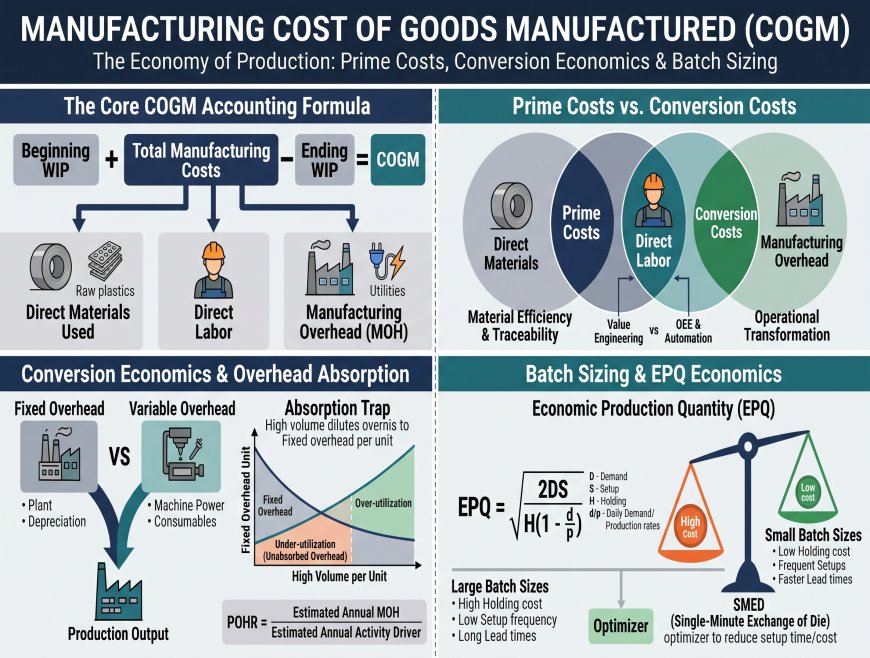
For industrial entrepreneurs, hardware startup founders, and mid-market contract manufacturing executives, sustainable commercial viability is determined at the physical factory floor level. A frequent pathology among emerging physical product enterprises is celebrating rapid top-line sales growth while remaining blind to unit-level cost escalation. Under-absorbed factory overhead, miscalculated direct labor allowances, and inefficient batch production schedules quietly erode working capital, turning apparently successful product launches into insolvent balance sheets. To establish genuine pricing power and maintain structural solvency, corporate controllers must master the master financial schedule: Cost of Goods Manufactured (COGM).
Unlike service businesses where expenses are predominantly operational and period-based, physical goods manufacturing requires capitalizing production expenses directly into inventory assets. Understanding how costs flow from raw materials into Work-in-Process (WIP) and ultimately into Finished Goods inventory is the foundational prerequisite for manufacturing excellence.
1. Anatomy of the Cost of Goods Manufactured (COGM) Schedule
Featured Snippet Answer Capsule: Cost of Goods Manufactured (COGM) represents the total direct material, direct labor, and factory overhead expenses incurred to convert raw inputs into finished inventory ready for commercial sale, calculated as: Beginning WIP + Total Manufacturing Costs (DM + DL + MOH) minus Ending WIP.
The formal COGM schedule integrates three fundamental manufacturing cost elements:
- Direct Materials (DM): The physical raw inputs directly traceable to the finished product. This is calculated as Beginning Raw Materials + Raw Material Purchases minus Ending Raw Materials, adjusted for non-recoverable production scrap.
- Direct Labor (DL): The fully burdened wages, payroll taxes, medical benefits, and production incentives paid to touch-labor operators and machine technicians directly engaged in assembling the product.
- Manufacturing Overhead (MOH): All indirect factory expenses required to support production operations, including plant facility lease depreciation, indirect shop consumables, plant engineering supervision, equipment preventative maintenance, quality control tooling, and factory utility expenses.
The Master COGM Equation:COGM = Beginning WIP + (Direct Materials Used + Direct Labor + MOH) − Ending WIP
2. Prime Costs vs. Conversion Costs: Strategic Dissection
Manufacturing controllers dissect total production expenses into two complementary analytical vectors to optimize distinct operational functions:
- Prime Costs (Direct Variable Foundations):
Prime Costs = Direct Materials + Direct Labor. These represent the direct, volume-sensitive cash outlays required to physically manufacture a single unit. Optimizing prime costs requires procurement scale, multi-tier vendor contract negotiation, volume rebate harvesting, and ergonomic assembly line cycle-time rebalancing. - Conversion Costs (Operational Processing Power):
Conversion Costs = Direct Labor + Manufacturing Overhead. These represent the operational investment required to convert raw materials into marketable finished goods. Optimizing conversion costs requires maximizing machine uptime, eliminating bottleneck idle capacity, adopting cellular manufacturing layouts, and automating repetitive assembly tasks.
3. Interactive Manufacturing COGM Engine
Model your production batch economics, direct labor run rates, and factory overhead absorption using the calculator below:
Manufacturing COGM & Unit Cost Builder
Adjust the interactive sliders and parameters below to calculate real-time figures for this scenario:
4. Batch Sizing and the Economic Order Quantity (EOQ)
A critical determinant of unit manufacturing cost is production batch sizing. Small production runs incur high machine changeover, setup calibration, and first-piece inspection costs per unit, inflating average unit costs. Conversely, excessively large production runs tie up expensive operating working capital in finished goods inventory and incur substantial warehousing, insurance, and inventory obsolescence risks.
Manufacturing controllers deploy the classical Economic Order Quantity (EOQ) formula to determine the exact batch sizing that minimizes the sum of batch setup expenses and inventory carrying costs:
EOQ = √[ (2 × Annual Unit Demand × Setup Cost per Batch) / (Annual Holding Cost per Unit) ]5. COGM and Unit Cost Matrix: Batch Size Sensitivity
The table below models unit cost behavior across varying production batch runs for an industrial component line requiring $6,000 in machine calibration and setup per run:
| Batch Sizing (Units) | Allocated Setup Cost/Unit | Prime Cost per Unit | Fully Absorbed Unit COGM | Commercial Margin Viability |
|---|---|---|---|---|
| 500 Units (Pilot Run) | $12.00 / unit | $28.50 / unit | $48.50 / unit | Negative Margin (Structural loss) |
| 2,500 Units (Standard Run) | $2.40 / unit | $24.00 / unit | $31.20 / unit | Healthy Tier (38% Gross Margin) |
| 10,000 Units (Scale Run) | $0.60 / unit | $21.50 / unit | $25.10 / unit | Optimal Scale (52% Gross Margin) |
6. Implementation Protocol for Operations Executives
To institutionalize precise unit cost accounting across manufacturing facilities:
- Implement Standard Work Instructions (SWI): Establish rigid engineering cycle-time benchmarks for every touch-labor operation to eliminate variance in Direct Labor absorption.
- Isolate Unallocated Factory Idle Capacity: Do not burden active production batches with the overhead of idle machines resulting from macroeconomic sales downturns. Treat idle capacity as a direct period expense rather than embedding it into inventory unit costs.
- Re-Benchmark Bill of Materials (BOM) Quarterly: Update scrap allowances, raw material commodity surcharges, and shipping inbound freight costs every 90 days to maintain accounting integrity.
7. Strategic Executive Summary
Unit-level manufacturing accounting is the ultimate competitive moat. By separating prime costs from conversion mechanics, optimizing production batch runs against EOQ limits, and precisely capturing factory overhead absorption, industrial executives command durable gross margins and achieve market-leading enterprise valuation.
5. Scrap Accounting, Yield Optimization, and By-Product Economics
In high-precision manufacturing, an uncalibrated scrap rate directly inflates unit COGM. Production scrap falls into two distinct accounting treatments:
- Normal Production Scrap (Unavoidable): Incurred as a natural byproduct of precision machining, stamping, or injection molding (e.g. runner sprues, metal shavings, edge trims). Normal scrap is treated as a product cost and absorbed directly into the COGM of good units produced.
- Abnormal Scrap (Process Defects): Resulting from operator error, substandard raw material quality, or uncalibrated machine tooling. Under GAAP and IFRS, abnormal scrap must *never* be capitalized into inventory unit costs; it must be expensed immediately on the income statement as a separate operational period loss.
6. Factory Unit Cost Audit Checklist
Plant controllers should conduct this manufacturing audit at the conclusion of every production run:
- Perform Cycle-Count Work-in-Process (WIP) Audits: Verify physical units on the factory floor against ERP production routing steps to ensure WIP inventory is accurately valued at month-end.
- Isolate Direct vs. Indirect Consumables: Ensure low-cost consumables (cutting fluids, fasteners, packaging tape) are treated as indirect manufacturing overhead rather than complicating direct material BOMs.
- Audit Machine Setup Hours Against Standard: Compare actual machine setup hours against engineering standards. Significant variances indicate operator training deficits or mechanical calibration wear.
7. Frequently Asked Questions
What is the difference between COGM and COGS?
Cost of Goods Manufactured (COGM) measures the cost of goods completed during the current fiscal period. Cost of Goods Sold (COGS) measures the cost of finished inventory actually sold to customers during the period (COGS = Beginning Finished Goods + COGM minus Ending Finished Goods).
How should overtime labor be allocated in unit costing?
If overtime is incurred due to general plant capacity pressure, the overtime premium is treated as indirect manufacturing overhead. If overtime is incurred specifically to rush a custom client order, the premium is charged directly to that specific batch as direct labor.



















Comments